MagicZendikar
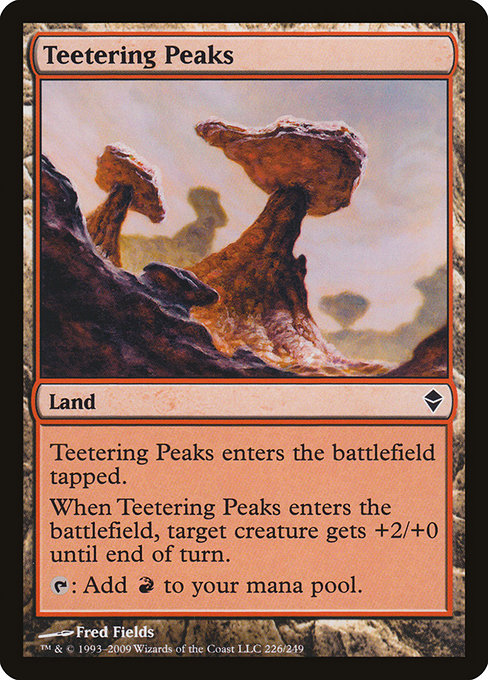
Teetering Peaks — Zendikar #226
Teetering Peaks is a common Land from Zendikar (2009), collector number 226, illustrated by Fred Fields.
Teetering Peaks price
Prices from Scryfall, updated daily, for near-mint copies. Indicative only — UK sold prices on eBay are often the best guide.
Card details
What Teetering Peaks does
This land enters tapped.
When this land enters, target creature gets +2/+0 until end of turn.
{T}: Add {R}.
Format legality
Other printings of Teetering Peaks
| No. | Card | Set | Rarity | Price |
|---|---|---|---|---|
| 9 |  Teetering Peaks Land | Friday Night Magic 2011 2011 | Rare | €0.56 foil |
| 30 |  Teetering Peaks Land | Premium Deck Series: Fire and Lightning 2010 | Common | €0.12 foil |
All 3 Teetering Peaks printings compared →
Questions people ask
How much is Teetering Peaks from Zendikar worth?
About €0.09 for a near-mint non-foil copy, and €0.61 in foil. Check UK eBay sold listings for what copies really sell for here.
How many printings of Teetering Peaks are there?
3 English paper printings, from Premium Deck Series: Fire and Lightning to Zendikar. The cheapest right now is the Zendikar printing.
Is Teetering Peaks legal in Commander?
Yes, it is legal in Commander.
Who illustrated Teetering Peaks (Zendikar)?
Fred Fields.
Pully’s Magic: The Gathering pages are unofficial Fan Content permitted under the Fan Content Policy. Not approved/endorsed by Wizards. Portions of the materials used are property of Wizards of the Coast. ©Wizards of the Coast LLC. Card data, images and prices from Scryfall.
Data checked · How we build our guides