MagicAvatar: The Last Airbender
Hama, the Bloodbender — Avatar: The Last Airbender #224
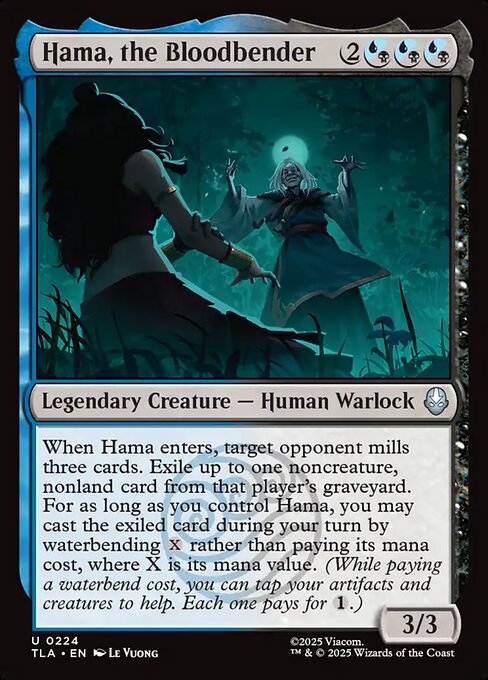
Hama, the Bloodbender is an uncommon Legendary Creature — Human Warlock from Avatar: The Last Airbender (2025), collector number 224, illustrated by Le Vuong.
Hama, the Bloodbender price
Prices from Scryfall, updated daily, for near-mint copies. Indicative only — UK sold prices on eBay are often the best guide.
Card details
- Number
- 224
- Rarity
- Uncommon
- Mana cost
- {2}{U/B}{U/B}{U/B}
- Colour
- Black / Blue
- Power / toughness
- 3/3
- Illustrator
- Le Vuong
- Released
- 21 November 2025
What Hama, the Bloodbender does
When Hama enters, target opponent mills three cards. Exile up to one noncreature, nonland card from that player's graveyard. For as long as you control Hama, you may cast the exiled card during your turn by waterbending {X} rather than paying its mana cost, where X is its mana value. (While paying a waterbend cost, you can tap your artifacts and creatures to help. Each one pays for {1}.)
Format legality
Questions people ask
How much is Hama, the Bloodbender from Avatar: The Last Airbender worth?
About €0.10 for a near-mint non-foil copy, and €0.12 in foil. Check UK eBay sold listings for what copies really sell for here.
Is Hama, the Bloodbender legal in Commander?
Yes, it is legal in Commander.
Who illustrated Hama, the Bloodbender (Avatar: The Last Airbender)?
Le Vuong.
Pully’s Magic: The Gathering pages are unofficial Fan Content permitted under the Fan Content Policy. Not approved/endorsed by Wizards. Portions of the materials used are property of Wizards of the Coast. ©Wizards of the Coast LLC. Card data, images and prices from Scryfall.
Data checked · How we build our guides