MagicAvatar: The Last Airbender Eternal
Momo, Rambunctious Rascal — Avatar: The Last Airbender Eternal #270
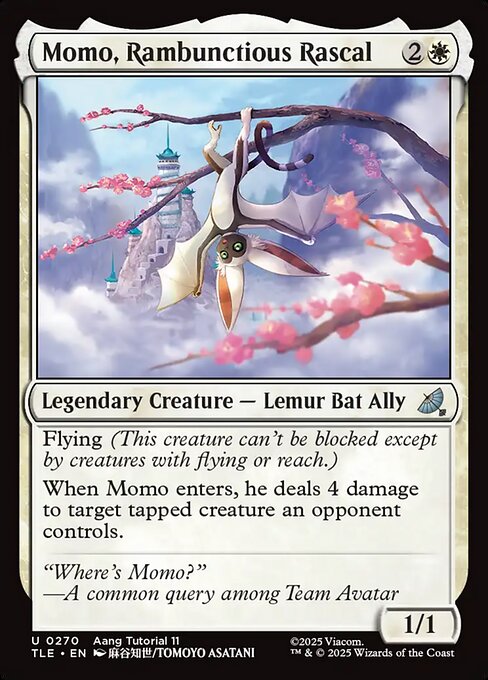
Momo, Rambunctious Rascal is an uncommon Legendary Creature — Lemur Bat Ally from Avatar: The Last Airbender Eternal (2025), collector number 270, illustrated by Tomoyo Asatani.
Momo, Rambunctious Rascal price
Prices from Scryfall, updated daily, for near-mint copies. Indicative only — UK sold prices on eBay are often the best guide.
Card details
- Number
- 270
- Rarity
- Uncommon
- Mana cost
- {2}{W}
- Colour
- White
- Power / toughness
- 1/1
- Illustrator
- Tomoyo Asatani
- Released
- 21 November 2025
What Momo, Rambunctious Rascal does
Flying (This creature can't be blocked except by creatures with flying or reach.)
When Momo enters, he deals 4 damage to target tapped creature an opponent controls.
Format legality
Other printings of Momo, Rambunctious Rascal
| No. | Card | Set | Rarity | Price |
|---|---|---|---|---|
| 217 |  Momo, Rambunctious Rascal Legendary Creature — Lemur Bat Ally | Avatar: The Last Airbender Eternal 2025 | Uncommon | €0.20 |
All 2 Momo, Rambunctious Rascal printings compared →
Questions people ask
How much is Momo, Rambunctious Rascal from Avatar: The Last Airbender Eternal worth?
About €0.23 for a near-mint non-foil copy. Check UK eBay sold listings for what copies really sell for here.
How many printings of Momo, Rambunctious Rascal are there?
2 English paper printings, from Avatar: The Last Airbender Eternal to Avatar: The Last Airbender Eternal. The cheapest right now is the Avatar: The Last Airbender Eternal printing.
Is Momo, Rambunctious Rascal legal in Commander?
Yes, it is legal in Commander.
Who illustrated Momo, Rambunctious Rascal (Avatar: The Last Airbender Eternal)?
Tomoyo Asatani.
Pully’s Magic: The Gathering pages are unofficial Fan Content permitted under the Fan Content Policy. Not approved/endorsed by Wizards. Portions of the materials used are property of Wizards of the Coast. ©Wizards of the Coast LLC. Card data, images and prices from Scryfall.
Data checked · How we build our guides